Grand not-quite-Palladian Jamaica Resort & Spa

Posted by luputtenan1 on Tuesday, May 3, 2011


An article appeared in the March 25, 2011 Observer.  It read: 
SPANISH hotel chain Fiesta has announced plans to carry on with its multibillion-dollar expansion of the Grand Palladium Jamaica Resort and Spa in Point, Hanover by a further 900 rooms with an aim to add an additional 2,000 rooms in the near future.

Billed as being located in Montego Bay, Jamaica (check the travel websites), this facility is actually located in Point, Hanover, which is 60km west of Montego Bay. 

Fiesta calls it the “Grand Palladium Jamaica Resort & Spa”, but what is a “Palladium”, let alone a Grand one?  The word “Palladium” does not appear in Oxford’s Dictionary of Architecture, nor any other architecture dictionary to which I am familiar because a Palladium is not an architectural term or reference.  Per the Oxford English Dictionary:

Palladium – a statue of Pallas whose preservation was believed to ensure the safety of Troy; a safeguard.

The word derives from the Greek Goddess Pallas Athena/Athena Parthenos, whose cult statue was housed in the Parthenon: that famous 2,450 year-old Greek temple atop the Acropolis.  Those of us in the field of architecture will immediately recognise the oft used misnomer.  The word the developers meant to use was PalladiAN.  From the Oxford Dictionary of Architecture:

Palladian – of or relating to a revived classical style (circa 16 century) in architecture based on the works of that famous Renaissance architect, Andrea Palladio; the overarching theme of which is that there is a correct way to design

Briefly, Renaissance architecture is characterised by an emphasis on symmetry and proportion, harmony, the regularity of parts, a reference to ancient Roman architecture, an orderly arrangement of building members such as columns, lintels, pilasters, etc, and the use of semicircular arches and hemispheric domes.  Palladio’s influence on Renaissance architecture was so profound and transcendent, his I Quattro Libri dell’Architettura, The Four Books of Architecture, which contain systematic rules and plans for building, is and has been in continuous publication since 1570.

Misnomer notwithstanding, this building reflects nothing of the works of Palladio, nor of Renaissance architecture and ideals.  In fact, its departure from the formal language of Classicism and Renaissance architecture is significant.  A subversion almost.  Parodic. 

The Façade
 
There are two types of facades to the facility: the main entrance façade and the facades to the suite clusters.  I will address the latter as they are seen more often on the premise.  When approached head-on, the secondary façade gives us the sense of entering a building with corresponding mass.  The perpendicular approach, however, reveals the façade as nothing more than a prop: a tilt-up storefront akin to those seen on the set of a Hollywood Western.

Quoins

Quoins:  large, square or rectangular stones used to dress and strengthen the corners of buildings, are a typical Renaissance feature.  They strengthen corners by ‘weaving’ together in order to bind two walls, ie, two intersecting planes, together.  Quoins stacked one atop the other in the fashion indicated here do not read as structural.  In this connection, the stacking implies the corner is not supported and this  portends structural failure.  Further, as aforementioned, quoins appear at the corners of buildings; not on the face of a wall or elevation as shown on either side of the entryway (see picture below).

Portico/ Pediments/Tympanum
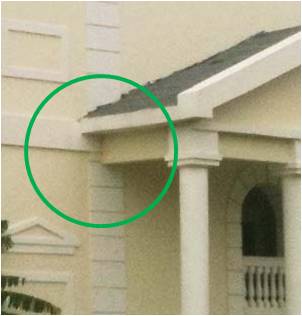
1.       Why were the columns in the portico: the porch area in front that supports a roof, not raised so that the 'band' below the roof, ie the entablature, would line up with the coursing that demarcates the second storey?  We’re talking a difference of about 6”.   This is just sloppy.  Analogy: how many of us have worn clothing that was cut so the pattern(s) in the cloth match and align?  The flower on a pocket that matches up perfectly with the flowers on the fabric it’s sewn to.  The 100’ angle made by matching the stripes from the lapel to the stripes on the collar as both pieces are sewn together.  This conveys the notion of continuity and makes a garment appear seamless.  This approach to transitions (of which Palladio was a master) is also done in architecture, but apparently not in this instance.  

There are no return columns or pilasters (flat, engaged columns) at the back of the portico (ie, where the roof meets the façade) looking as though the roof is only supported at the front, which means the back of the roof is about to collapse.  Yes, we know that there is a supporting I- beam in there, however, steel was not used as a supporting element in Classical architecture, hence, we shouldn’t have to cognitively rely on it to interpret a building done in the Classical typology.  Note also that the roof slams into a string of quoins on the face.  That's one crazy juncture right there.
   
2.       The pediment is any one of the triangles you see at the front (see facade picture above).  There is one at the front of the portico roof, one above it (referred to as a broken pediment, for obvious reasons) and two small ones on either side of the doorway.  Though there is precedent for the double pediment (see the Pantheon in Rome) I’m not sure what purpose the broken pediment in this case serves.   If it is decorative, then a poor job was done.  It seems more an afterthought: something made up to finish the façade.  The pitch is way too flat to be convincing and the purpose of the circular cut-out is a mystery.  I can reference no precedent for it.

3.       The tympanum (recessed centre of a pediment) is treated one of two ways in Renaissance architecture: left plain, or highly decorated with relief sculptures.  Here we get one tiny, lionhead appliqué.  Stingy.

Appliqué – a cutout decoration fastened to larger piece of material.

Doors/Windows/ Niches

Renaissance doors are typically square but set within an arch or surmounted by a pediment. Openings without doors are typically arched, with a keystone (see spa area picture below for how not to do these openings).  Additionally, door surrounds are rusticated (stone cut so that the joints are sunk, the face is roughened and projects beyond the façade).   Note the doorway in the façade.  Quoins present throughout the entirety of the two-storey archway.  Let’s give Fiesta one tick for an attempt to convey a rusticated door surround.  However, the arch itself is grossly incorrect.  There is no keystone in the centre (the crown) of this arch.  In fact, the centre of this arch is the grout line between two stones!   The keystone is called such for a reason.  Located at the centre it actually ‘locks’ an arch in place so is thereby structural.  Removal of or the absence of the keystone (cognitively, as this building is concrete and not masonry) results in the collapse of an arch. 

Made me queasy, walking under such a structure.

Similar rules apply for windows and niches, excepting the rusticated surround.   There are no windows  in this façade but we see two niches on either side of the ‘failed’ archway, which needed to be rendered more convincingly to not read as more appliqué. 

The Spa

A bit more effort was spared in executing the double columns of the pergola in the pool area by the spa by giving them capitals and somewhat of a base.  Columns are load bearing members, proportionally sized to bear a corresponding load.  These double columns are obscenely oversized to bear the load of such modest wooden beams.  Either the beams need to be larger and the columns smaller, or vice versa.   Incidentally, the beams are oriented east-west, which defeats the purpose of it being a shading device.

A frieze is the horizontal central band below the cornice and above the architrave (see picture), all three of which comprise the entablature.  In Renaissance/Palladian architecture, the frieze is treated according to the order (column type) used.  Because of the lack of ornamentation on the vast majority of this building’s columns, I generously assume the designer is using the Tuscan order.   If so, then the frieze is to be left flat and unornamented.  Other orders dictate the use of a flat frieze: the Ionic, Corinthian and Composite, but none of the columns we see here resemble such, so I’m going with the Tuscan order. 

In some instances we see no ornamented frieze and in others we get the one repeated appliqué.  Friezes, when decorated, typically tell a story in pictures.  Here we get the same image over and over and over: a reclining maiden in bas-relief.  No story here; just a one liner.  The spa building shows the appliquéd maiden alternating with some very obvious downspouts.  I trust I don’t need to say that one would never see a downspout punching through a frieze on any Classical building.  All buildings need a way to channel water away from them.  This is typically done discreetly and well incorporated in the design.  (Eg, gargoyles are actually waterspouts that channel rainwater away from their buildings.)  The repeated use of the reclining appliqué seems like an afterthought.  It is a very cheap, unattractive move and I wonder why even do it at all?

The Dome

Gleefully abandoning all Renaissance and Palladian tenets of symmetry, proportion and beauty, Fiesta's contractors set to thrice render colossal bastardisations of Brunelleschi’s beautiful, ingenious, watershed moment of a dome that crowns the Basilica di Santa Maria del Fiore, Italy.  The results in Point, Hanover beggar belief.  Two proudly sit on either end of the main building and one atop the spa building.  Looking as though they were moulded from hulled potatoes, there is nothing ‘domey’ about these wonky domes. There is nothing symmetrical about them and they are only loosely hemispheric: the untrained eye can clearly see that they descend beyond any hypothetical equatorial line.  They are poorly rendered, with over-subscribed ribs that indicate a clear misunderstanding of the Master’s brilliant use and invention of the originals (designed to resist lateral thrust in the absence of buttresses), and tiny, unaligned, understructured - thus unconvincing - members transition the domes’ circumferences to the square of the roofs.

Other instances continue to shock and dismay as one progresses through the property, including:  the ceilings under the outdoor walkways are mouldy, indicating improper installation of the asphalt tiles (I’m guessing that if I peeled back a tile I’d find no waterproofing membrane nor felt between tile and roof sheathing), and downspouts that empty into the colossal pool.  I wouldn’t assume that the runoff water from the roof is filtred, strained or treated in any way.

The rooms and gathering areas are executed tolerably well, which only underscores the dissonance between interior and exterior.  The former tries hard to compensate for the latter.  It succeeds as much as a double-wide mobile home with granite countertops and stainless steel appliances does.

This facility is pitiful all round and KITSCH punctuates every aspect of one’s experience of it, from its architecture to its amenities.  Kitsch: that all-encompassing German word that aptly describes a vicarious experience of faked sensations.  Guests line up at all-inclusive feeding troughs for tinned ackee (horror of horrors).  One has to search far and wide to get a cup of decent coffee AND the milk to go with it as powdered creamer is all that is in the offing in this swanky establishment.  (I resorted to getting my coffee from the gift store sample cart.  And by coffee I mean the Jablum stuff in the crocus bag; marginally palatable under normal circumstances, but a welcome reprieve in this setting.  So I had to drink four sample cups for a full serving…at least they had liquid milk.)

The landscaping comprises a few banana trees, a few Royal Palms, a couple nondescript shrubs, one variety of croton and one variety of Joseph’s Coat.  And for all the sand stealing that made international headlines and Ripley’s Believe It or Not, there is no beach to speak of here.  The beach is mucky, murky, seaweedy and gross (see aerial photo).  Hence the colossal pool.  Even the diving here is kitschy.  Forty-five minutes under water peering through muck at a denuded reef, one tired sea cucumber, a couple chromis and too many lionfish.

Per the Oxford Dictionary of Architecture:

           Kitsch - Rubbish or trash.  The term suggests works in any of the arts that is pretentious, shoddy, tawdry, inferior, and in bad taste, aping styles without understanding them, and vulgarizing them beyond redemption… the cultural revenge of the lower classes….

Ahhh.  There we have it.

Jamaica is not starved for incredible examples of fine buildings, Classical and vernacular.  Any of our parish churches (Georgian and Gothic revival styles), our courthouses (often rendered in the Neoclassical), and Greathouses (Neoclassical and vernacular, ie, Jamaican Georgian) will attest to this.  So too will many of our hotels (Half Moon – Palladian, Round Hill and Strawberry Hill – Jamaican Georgian, deMontevin Lodge – Jamaican Victorian).  Yet how often nowadays do we see the preponderance of kitschy buildings being passed off as progress?  When did this reductive way of being enter our collective psyche?  Why is kitsch becoming a dominant facet of our culture?  What does it say about us and our opinion of ourselves as an intellectual society?  What does it say of what the Spanish (Fiesta and otherwise) think of us as an intellectual society?  From the march 25 Observer article:
Yesterday, Spanish ambassador to Jamaica Celsa Nuno said the development was "an indication of very positive economic recovery and more than anything an indication of the confidence of the Spanish investors in the future of Jamaica".

Hands up those of us who believe that Fiesta could or would erect this joke of a resort in, say, Cinque Terre.  Côte d’Azur.  Heck, Varadero, even.  It would never happen.  No, non, y ¡difinitivamente no!  Yet we Jamaicans lap up this aberration for the jobs it will supposedly create (mostly menial) and the tourist dollars it will bring:
The tourism minister said this phase of the development will cost US$280 million while the next phase will include "interesting and novel attractions which will be a key part of what is going to drive the higher spend". Bartlett said more than a thousand workers will find employment in the first phase and over 3,000 ultimately.
According to Bartlett, the recent opening of the largest port in the Caribbean in Falmouth, Trelawny, which has already had its first call from the world's largest cruise ship, was indicative of the necessity for more rooms.

Can someone please tell Minister Bartlett that Point, Hanover is all of 100km away from Falmouth, Trelawny?

Kitsch is dangerous.  People pay to see the faked article.  Our smarmy leaders know this and also know they only have to pander to the lowest common denominator.  Impress this ever increasing segment of the population with whatever trinket is being offered and parliamentary votes remain secure.

Kitsch is vulgar and invasive.  Look at Sandals Whitehouse, the latest addition to the Sandals family, and compare it to its siblings.  It alarms me that even the mighty “Butch” Stewart has fallen prey.   There is much talk about the loss and degradation of Jamaican culture in the news, but the best our intelligentsia can do to address this is insist on patois being taught in schools, insist that the bible be printed in patois and defend Vybz Kartel's stint as UWI guest lecturer.  

Language is not the only embodiment of culture.  Architecture also serves a similar purpose.   Why allow such vapid eyesores to front as monumental and experiential representations of Jamaica?  For that is what these structures do and they do it to our cultural detriment.
Tourism Minister Edmund Bartlett said that the future plans for another 2,000 rooms would "make that facility the largest mega tourism entity in the Caribbean today".

He says it like it’s a good thing.

I advise those with sand to be stolen to keep watch.

Footnote:

One thing that’s glaringly absent from Fiesta’s attempt at Palladian architecture is the ubiquitous Palladian motif:  a semicircular arched light (opening) flanked on either side by lower rectangular lights (openings).  My guess is that this was excluded only because a) it costs more (labour, materials) to do an arcuated opening, b) Fiesta’s designers probably have no idea what it is anyway, or a quite probable c) said designers assumed Jamaicans have no idea what a Palladian motif is, and can't tell the difference between it and a patty flanked by a coco bread.

Drawing by Palladio from his Four Books...


- Torsdag
More aboutGrand not-quite-Palladian Jamaica Resort & Spa

Jamaica: Crime Real or Imaginary

Posted by luputtenan1 on Tuesday, April 26, 2011

Deep down in the subconscious mind of every Jamaican living in a foreign country is the desire to return home, even in the minds of most “Use To Be” Jamaican. I believe that this attraction, this salmon like drive to return to ones homeland is so great that some Jamaicans are forced to find various ways to resist this temptation and to fight the instinctual urge but yaard is calling. 

 The salmon swims upstream in a desperate attempt to return to their place of birth trying along the way not to get eaten by Bears and in the case of Jamaicans, they would like to return home but do not want become a victim of a crime. Crime real or imaginary represents 90 percent of Jamaica’s problems, it is the number one entity that is limiting progress and slowing our social and economic development, it is the reason why our nation building initiative since independence have not been as successful. The world wide perception of Jamaica and Jamaicans is that of crime and drugs and yet even against these odds we continue to hold our heads above water, so just imagine what we could achieve if we were to bring about a solution to the problem of crime.  Economic investment in a stable Jamaica would increase to unimaginable levels. The rippling effects of such investments inflows throughout our society would benefit each and every Jamaican. As per the IMF Jamaica’s GDP would increase 5% if the Government was to find a solution to crime, in my view that is a conservative estimate. 

Most Jamaicans living overseas would gladly return home, it is not the lack of economic opportunities that is preventing their return but instead the perception that they will become a victim of crime. The very idea of spending most of your life, working hard, night and day in another man’s country only to come home to become a victim is scary. Crime limits our freedom to be innovative, crime limits our freedom of self expression, our freedom to not only take advantage of opportunities but to create new opportunities that drives social and economic development and

"crime also limits our freedom to design.  So many houses are spoiled by a plethora of grille. Around the windows, behind the door, INSIDE the house: a corridor, a bedroom... Houses look like bunkers because people don't want outside looking in to case the joint..." (as per -Torsdag)


If a solution was found then even the most anti-Jamaica Jamaicans would be forced to come to terms with the fact that Jamaica is a viable option.


Selling the idea of crime is also big business with the introduction of All-Inclusive resorts, hotel owners have introduce crime as a selling point, saying it is better to stay in an all-inclusive compound because it’s safer, they will pick you up from the airport and deliver you back to the airport thus isolating you completely from those scary Jamaicans, their job is to scare you into their resorts and your money in their pockets.

Real estate developers also sell crime with the introduction of the Florida style Gated Community/Compound, crime is now a major selling point, 24 hour security lock down is now a feature, everything is made available even a quickie mart so you can shop without leaving the confines of the compound as they declare that this is where you need to live because it is not safe out there, just 25, 35 50+ million Jamaican dollars is all it takes.


Retiring Jamaicans living overseas would love to spend their last days in Jamaica, they dream of the day they can return home to sit on their verandahs or relax in the back yard, to feel the cool tropical evening breeze and watch the sun set over the Caribbean sea, to live out the rest of their days in peace and harmony but they are afraid to make that move and the number one reason is crime, they do not want to be set upon by criminal elements of our society. Most of our retiring Jamaicans in faraway lands are now looking to other countries with low crime rates and decent standard of living to retire, this not only represents income lost as their retirement income would be forwarded to other countries but also represents the lost of solid experience, their wisdom and maturity is required by our society, they have a part to play in the Nation Building process and we should do everything in our powers to keep them safe.

In 2006 The Bank of Jamaica estimates that 15 per cent of remittances are pensions for returning residents                

Localisation of Crime in Jamaica
The number one concern for returning and visiting Jamaicans is the issue of crime and rightly so, no one wants to return to a place where guns are barking every night like “mawga” dog on the street and bullets passing your ears more times than buzzing mosquitoes. But if we take the time to study the pattern of crime across the island one would realize that the majority of murders and criminal activities are localized to handful of parishes and very localized within those parishes to a hand full of ghetto locations. If one could look at a murder map of Jamaica, one would realize that the vast majority of Jamaica and Jamaicans are safe and living in peace, the people in these places rarely hear a gunshot or experience any crime what so ever. We have three Counties and 14 Parishes in Jamaica with a population of over 2.8 million people and most of those people and location go about their business in peace and enjoy life as much as anyone else in the world.

I am by no means saying that Jamaica does not have a crime problem, it is a fact that our murder rate has been over 1000 for the past couple year but 98% of those murders occur in handful of Ghetto communities with in a hand full of parishes and everyone can list these troubled no-go communities. We know which ghettos in Kingston, St. James and Spanish Town and we know to stay clear of them and they seem to stay clear of everyone else.  A 2006 Gleaner-commissioned poll by pollster Bill Johnson showed that most Jamaicans feel safe living in their country. Johnson interviewed 1,008 persons for the survey which was conducted March 5 and 6 in 84 communities across the island's 14 parishes. The poll has a margin of error of plus or minus three per cent. An overwhelming 83 per cent said they felt safe living in their communities, while 14 per cent said they did not and three per cent said they did not know.  Even though 83% felt safe the majority understands that crime was a major problem. A study carried out by Women's Media Watch shows that Jamaica, in comparison to other newspapers worldwide, reported less on the economy and more coverage were given to crime and violence.  Sometimes I get the feeling that Jamaicans are addicted to bad negative news report. Recently “On the Grounds News Report” reported on some good news from Jamaica and the majority of people responding on its messaging board declared that the item was not news and was a waste of time.

If one returning resident becomes a victim to crime then this is translated by the Diaspora to say all returning residents are targets. Crime against tourist is very low but if a crime is committed against one tourist for the entire year, then the  overseas press will make it look like tourist are being attacked, left, right and center and before you know it, a travel warning is place against the entire country. Recently two British tourist was shot and killed in Florida simply because they were in a certain area at a certain time, every country have these no go high crime areas and Jamaica is no exception. There are parts of London I would never go to, parts of New York you would never catch me dead in and there are parts of Jamaica that I would never ever set foot in but in the case of Jamaica the outside world sees all of Jamaica as a no go area and part of the reason for that is how we portray our country in the media.

One of the problem or recent development is that these days we are now so very connected, a fender bender car crash can happen on Hope Road at 3:00PM and at 3:02PM news of the crash is instantly broadcast to Jamaicans worldwide, Jamaicans living in Germany are aware of the accident as Global satellite systems disseminate information at the speed of light to internet servers and smart high tech hand held devices worldwide. Back in the days if three murders happened today we may hear about 2 in printed or electronic media the next day or over the next couple days and a fender bender would never even make news that would just be idle chatter by the people who saw it. People outside of Jamaica may never hear of it at all, the Daily Gleaner used to be monthly in the UK and people in NY would have to wait for the Star to publish every couple weeks, so most crime would go by with most Jamaicans at home and abroad not knowing it ever happened.
On The Ground Murder/Death/Kill Bad News Report
Coupled with the fact that news media’s are competing with each other to see who can find and report the most negative news, because bad news sells and is addictive to most Jamaicans. We are now bombarded up to the nanosecond with every criminal activity, every accident, every little thing and at the rate it is coming in, it has started to have on effect on the minds of Jamaicans worldwide, we cannot assimilate that much bad, disgusting information, at that rate, about our little rock, our island in the sun.


Over the past couple days I decided to do my own research on how crime is reported in other countries, take the UK for example, I decided to go through the major online English newspapers then cross check with their Police website and statistic on crime.  I found that the Guardian, the Independent and The Times UK had a special drill down section on crime and that across all media outlets most crimes did not make the front, middle or back page unless that crime was committed in another country or just too gruesome to ignore. The front page was taken up with football, politics, state of the economy and wars in other countries.  Yet the London Metropolitan Police reported that in London the Number of crimes for the last 12 months to March 11th 2011 was 822,596 and 3,460 gun related crimes with 165,891 as violence against another person.  Only the guardian went on to explain that the crime figures coming out of the UK cannot be trusted because whichever party  forms the government tries to manipulate the figures to show that they are winning the war on crime and keeping Britain safe. It is also clear that the British media have better things to report than to bombard the general public with crime details, they also understand the economic importance of not saturating the air wave with crime. 


Our number one export in Jamaica is our young people, from birth each Jamaican parent begins the process of planning and plotting the time and place of their child’s export. In some cases this is done because they want the best for their child and thinks that only through export will they achieve this. However once exported there is no guarantee that these young Jamaicans will return with the new found experience and knowledge they acquired on their travels and studies and the Government is not trying to get them back either, instead trying to get them to send home the remittance money. It would be nice to see some statistics on what percentage of these exported young people actually return, by my estimate, it is around 3 out of 10, on the other hand I would say 8 out of 10 would start the process of sending money home to their families. According to the World Bank, 80 per cent of Jamaica's graduates of tertiary institutions are abroad.This represents a brain drain on our society, a lost of its human resources, Jamaicans who are needed for innovation and development but by pimping out our offspring’s and various relatives we gain cold hard cash, this situation is so deep rooted that our government now create budgets around remittances and remittances is now a sector, much like construction, tourism and Bauxite/Alumina. I say this because I believe to a certain extent that Jamaicans in Jamaica sells suffering, hard life and crime in exchange for cold hard cash, it is now a gimmick used even by the Government and the people to encourage people and entities to make certain funds available.  I cannot imagine a person calling their relatives abroad to say that life is great, everything is perfect and they have a party to go to tonight and a dance the next night and by the way can you send me some money, I cannot imagine that strategy would work.


 Here is a situation that always amazes me, I am having a conversation with a fellow Jamaican, the topic of crime comes up and he begins to tell me how dangerous and disgusting everything is, a long list of crimes from around the island is detailed, in areas he has never been to and in the same breath he begins to tell me that the wine tasting at Bin 26 was fantastic, the fashion show was great, Jazz night at the club was perfect, the Quad, Cuddy's and countless others was kicking it and tonight he has a session or two to go to but first he must stop at Truck Stop Bar and Grill for a bite to eat, it seems we talk about crime like how the English talk about the weather. For a country that is supposed to be under siege from crime we do not have much of a problem when it comes to enjoying ourselves, nothing will stand in our way when it comes to merriment, well except rain, to a Jamaican there is no difference between rain and fire and brimstone falling from the sky, they are treated the same (Run!).

In the early 1990s I went to visit a friend who lived up Jacks Hill, I remember sitting by his pool as one of two house hold helper served us a couple of beers, during the conversation I mentioned that I would love to return home at which point he went into a long speech trying to convinced me that Jamaica is no place to return to. Now here I am sitting in the sun, cool tropical breeze next to his pool looking out at the skyline of Kingston being served by his house maid while he tells me how hard life in Jamaica is and that he himself is considering migrating, I think he tried that once and then decided that no where no better than yard as he returned to home sweet home, with the pool and helpers.

The main reasons why our young people do not return to Jamaica is (1) the fear of being a victim of crime real or imaginary and (2) the feeling that there are no opportunities available to them in Jamaica, no way to make a living, failing to realize that this country needs them to create opportunities. A third (3) reason is that people in Jamaica tell them not to, it is not in the best interest of some people in Jamaica for them to return, else no remittance, for short term financial gain we are willing to sacrifice the future of Jamaica. Without innovative minds there will be no positive change within our society and stagnation sets in.  These people will give you 101 reasons not to come home, except the main reason, “when you come home whom do I call and ask for money”. (4) The things some people do overseas to make a living they would never do it in Jamaica, working 2 or 3 jobs to make ends meet is a foreign concept, most believes that upon returning to Jamaica they should automatically "run things" regardless of education level and/or work experience. (5) Competition with local Jamaicans for scares jobs, in the early 90’s before the financial meltdown it was reported that educated Jamaicans were returning at an alarming rate, so much so that Jamaicans at home began to complain that the returning Jamaicans was taking away their Jobs, they could not compete as Companies preferred to hire returning resident instead of the locals. The perception at the time was that returning residence had a better attitude towards work, a much better work ethics than their local counterpart that coupled with the fact that they had first world experience also the real estate market is priced for buyers in the United States and Great Britain, the good thing about this is that by buying a stake in Jamaica, overseas residence are forced to take an active role in the direction of the country, if only to preserve the value of their investments.

The other day I was reading about Pheasant Shooting and I realized that during the off season the estates put out free food and water for the birds, as such they become accustomed to certain areas of the estate, the thing is, during shooting season this was also the area for the guns to shoot the fatted fowls, the price they paid for free handout.


It is my view that remittance and international loans hurts us, people have become accustom to being fed and taken care of and as such their minds now turned to putty, why bother with innovation and creativity when all you have to do for a few shorts minutes is sell poverty, death and destruction to anyone willing to listen.  There are people in Jamaica who does absolutely nothing except wait for that call on one of their 3 cell phones, from Western Union and why not … they are getting paid, crime might be a problem in Jamaica but embellishing crime and hard life is also big business.

2006 Report on Remittance:
Category                US$ Million
Remittances          1204
Bauxite/Alumina      770
Tourism                   389
Sugar                     60.2
Rum                       34.5  

-----------------------------
-----------------
America Does it, Trinidad Does it, Britain Does it, most countries worried about investment and perception does this... But Jamaica Flaunt it's Dirty Laundry... We use it as a begging gimmick.. Look how we a suffer beg you a money. 

"PORT-OF-SPAIN, Trinidad (AP) — Former world soccer vice-president Jack Warner wants to stop the release of crime reports and statistics in his capacity as Trinidad's national security minister, saying that publicising such information encourages people to commit more crime."
Read more: Trinidad's national security minister wants to stop the release of crime reports and statistics

NYPD leaves offenses unrecorded to keep crime rates down
Read More: Police Tactic: Keeping Crime Reports Off the Books

NYPD Crime Stats Manipulation Widespread, Must Be Investigated, Criminologists Say
NYPD Cooking the Crime Report Book

Metropolitan Police amongst 18 forces to have 'under-reported violent crime for 10 years' The UK's largest police force and 17 other constabularies have been under-reporting the amount of serious violent crime.


More aboutJamaica: Crime Real or Imaginary

Keep it Arsenal !

Posted by luputtenan1 on Friday, April 22, 2011

 I think I have calmed down enough to write a blurb about the Sp*rs vs Arsenal match and the state of the Arsenal. I had hoped that this squad would at least understand the importance of beating the scumbags but I think with this squad that is asking for too much. There was a time when 3 up against a side would mean game over, done and dusted but not anymore, these days we can score 3 or 4 before halftime and still end up losing or drawing the match, it is so predictable that Arsenal supporter now live by the motto “it’s not over till it’s over”, we just do not trust this squad of players to deliver the glory for Arsenal FC, that it seems, is asking too much. 

Yes they play beautiful football, have been for 2 or 3 seasons now, but we know the real beauty of Football is winning, all the fancy passes and twinkle toeing into the box means absolutely nothing if at the final whistle we do not come away with 3 points. I do believe this season is over for us, the other top three clubs are just too mature to give any grounds, they understand that they are on the field of play to dig out a result and come away with the 3 points. Now we are in a battle for second place and I would not be surprise if we ended the season in third (Please prove me wrong), we lack a proper defense and a strike force to tear other team’s defense apart when it really matters.  Gone are the days when we take the lead and shutdown the game, when Henry would take the ball to the corner flag and keep it and the defense would make it impossible for anyone to score while still being dangerous up front.

Arsene Wenger’s post match reports are becoming more and more of an Annoyance but I do understand why they are the way they are, Wenger during the season cannot come out and give the squad a public bollocking, he cannot afford to be negative while we still have matches to play, so he is forced to remain positive and give the squad his full support. It is a shame that his great experiment failed, if it had succeeded then the other over spending clubs would have become the laughing stock of English Football, it would have been a slap in their faces, look what we can achieve on a shoe string budget and some young players. 

 “I'm convinced if we win our last five games we will win the championship”
-Arsene Wenger (April 22, 2011: BBC) (How I wish)

Wenger has lost his sharpness, his ability to uniquely identify problems and fix them before they manifest themselves on the field, this squad was always 2 or 3 players short of becoming the perfect Arsenal Team, his second weakness is the 7 or 8 dead weight players we still have in the squad, imagine taking off Wallcot and Nasri to bring on Arshavin and Bendtner that to me was a mistake. Wenger’s announcement that being second is OK will not win him any favours, after all “We are the Arsenal, we run things, things don’t run we” 

Arsenal Till I Die!!


More aboutKeep it Arsenal !

RE-Brand Jamaica

Posted by luputtenan1 on Wednesday, April 13, 2011

What is Jamaica, the brand? What is the image your mind conjures when you think of Jamaica? Sunny beaches, ganja and guns perhaps? Or how about laid back work ethic, homophobia or backward banana republic on the brink of civil unrest? Credible words or great misnomers?

An American colleague remarked, “My wife and I have been going to Jamaica now for 8yrs we just love it.” Then he paused, took a deep breathe and said, “But don’t you feel as you drive to the compound and see those shanty huts that any minute now they might rise up with machetes!”


Bangkok street riots

This is ‘Brand Jamaica”? Is this fear of a black planet or fear of the folklorist bravado that Yaad likes to perpetuate; the bombastic bad bwoy Buccaneer. We know this is the media image of Jamaica, search online and you will be floored by the amount of off-balance reporting and negative reports on gangs and drugs. During the time of the Dudus drama you would think the whole isle was ablaze with unrest and uncertainty. A time that cost Jamaica dearly. Meantime in Bangkok street riots took many lives but still Conde Nast placed the city as the Best Place to Visit. Proof that it is perception not reality that reaps the revenue.

Ironically, it’s the tourist beach hustlers who understand Brand Jamaica more than anyone. It’s a symbiotic relationship; the tourist start with their need for drugs or their yearning for sex and it end in a toxic trade and an understanding that the more brazen they are the more most tourists will in intimidation, pay. They understand that the key factor in revenue for Brand Jamaican spending is entrenched with fear and distrust. They have cleverly capitalized on this with lotharian tactics that flip on a dime to aggressive hustling and intimidating swagger.

More sluggish to catch on is the Jamaican Tourist Board. The approach of the JTB is that of a band-aid on a cancer. When your brand image is that of unrest, corruption, danger, drugs and guns, a pretty picture of an exotic beach won’t work. More pretty picture campaigns and a social media push that posts banal “How is your day” posting to the thousands of potential customers. However, it is clear their strategy is to build up “all inclusive” market, (a mainly foreign owned industry). A strategy that shoots the brand in the foot as it fortifies the salient factors that Jamaica is not safe and the locals are not to be trusted.

When there’s negative brand connotations the key strategy is to change that perception fast before it spreads. Deflection is a weak tactic when you are up against a media tsunami of negative misinformation.
 

 Identifying the main issues as fear and distrust in the brand. Knowledge, perspective and exposure to facts will reinvigorate the lost revenue. Steering revenue to the smaller hotels of Jamaica and encouraging tourists to visit Kingston is key towards the transparent drip of trust. The fact that JTB pretty much ignore the smaller hotels and Kingston again strengthen the fear. JTB need to stop herding their social media masses to endless banal clips of reggae artists videos but post human interest stories of real people in real communities doing great initiatives alongside pretty pictures. Show the cosmopolitan aspects of the people and the culture. Applaud the victories in education, industry and the arts. Bombard people with facts and real perspective. During the Dudus drama not one major media put out that Tivoli was the size of Sandals resort in a small contained area miles from any tourist area. When there is a hurricane the story is the same huddles masses of foreign journalists relish in the scaremongering, “A city on the brink of Civil Unrest” I heard last time on CNN. Then there’s other media reports like that video report on the Wall Street Journal about returning Jamaicans who come home for retirement but invariably killed in robberies. Who is managing Brand Jamaica here? Where are the global media watchdogs who protect Brand Jamaica and where are the lobbyist groups who instigate the more truthful real balance in reporting. What litigation surrounds to protect Brand Jamaica when such unbalanced reporting continues.

This re-brand needs to be a cross platform initiative to survive and really reap the potential global revenue. Manufactures of Jamaica need to protect and promote “Buy Jamaica” to rebuild that trust and knowledge that the country has authority and is worthy of investment. Education should have a component in to build back the pride the people have in the land and culture and should also tie into the Buy Jamaica ethos. Politicians need to be mindful of the Brand Jamaica image when they play verbal ping pong throughout each campaign promoting crime stats and the other parties corruption. Jamaica is the only nation in Caricom who print so grandiosely the crime statistics. Meantime, throughout the rest of the world crime statistics are ‘re-classified’. What use is this negative branding?

Local media needs too to be held accountable with watchdog monitoring committees. Accountability is key in order to bring back Jamaica the positive brand onto a global stage for revenue potential.

Who is driving this brand and what is their strategy? I think they are asleep at the wheel.

Jane Nina Buchanan
jane@stooshpr.com
www.stooshpr.com
Originally from Liverpool, England Jane started her career as producer and presenter of the SONY award winning show "Streetlife" on the BBC. From radio she moved on to television with seasons as Entertainment Producer for the network Granada TV show, "This Morning" and later "Jameson Tonight" on Sky TV. Headhunted from Sky TV by Sir Bob Geldof and Lord Waheed Alli company at 25yrs old, she was appointed the position of US Producer for Planet 24 Productions. Based out of NYC she coordinated and produced all US strands for the controversial show "The Word" and later, "The Big Breakfast". When Planet 24 relocated to LA to produce the successful "Survivor" reality show, Jane decided to make NYC her home and continues to live and work in the media. She has held positions at New Video Group/Docurama (Home Video arm of A&E/The History Channel), Disney Theatrical (Lion King,, Mary Poppins and Phil Collins' Tarzan) Maxim Magazine/Dennis Publishing, and Bad Boy Entertainment.


Branding, Marketing and Public Relations
More aboutRE-Brand Jamaica

Collective Guilt?

Posted by luputtenan1 on Tuesday, April 5, 2011

Collective Guilt - The unpleasant emotional reaction that results among a group of individuals when it is perceived that the group illegitimately harmed members of another group. It is often the result of “sharing a social identity with others whose actions represent a threat to the positivity of that identity. 
-Wikipedia

Most Jamaicans lose their minds whenever they hear that a black person in England or in America is charged with a crime, they would log on to various messaging boards, posting messages of hope, that the culprit is not a Jamaican or of Jamaican origin. It seems that Jamaicans regardless of geographic location suffer from collective guilt and shame only when a person of Jamaican origin, who lives in a foreign country, commits a crime, however no such guilt exist when a Jamaican commits the same crime in Jamaica. 

If one Jamaican commits a crime in a foreign country he is blamed for making all of us look bad…  US?  …. Excuse me... where did this “US” thing come from?

Why should I share the guilt and shame for another man’s crime when I am a hard working and law abiding person and he is a damn criminal, when did this become my responsibility, my shame and my guilt even thou it was not my crime. I do not see this collective shame and guilt happening in the first world, so it must be a third world thing. When a white American or British citizen travel to faraway lands and commit crimes like murder, drug smuggling and child molestation I do not see collective guilt coming from the people of these countries. When their Governments sends their armies to some poor third world countries and drop 500lb bombs on innocent woman and children, I do not see them holding their heads in shame. When they are caught at my airport trying to smuggle drugs out of the country I do not see collective guilt and shame form their countrymen. I have as much control over the hearts and minds of my fellow Jamaicans as an American or British would have over their citizens and I have no control over a person who is a citizen of another country but either descended from a Jamaican or migrated from Jamaica at a young age.   

This collective pity party by Jamaicans must stop, this is meaningless collective punishment, I know you are concern with how people in the outside world will look at you or treat you but believe me, regardless of what you do certain people will only look at you the way they want to look at you, even if you have a halo above your head and wings on your back. What is more important is how you view yourselves and others around you, refrain from making generalized statements,  take each person one at a time, there are some good people in this world and some very bad ones regardless of colour and nationality. If you have not broken any laws and you are good honest hard working inhabitants of this planet then you have nothing to be ashamed for or feel guilty about.  

The British media takes extra pleasure in identifying black British citizens as either Jamaican decent or Jamaican born, even when that person have never been to Jamaica or left Jamaica at birth. Take Germaine Lindsay for example (No seriously …. Take him because he is yours) the British-Bomber of “Jamaicans descent” was described as Jamaican. The man was born in Jamaica, yes but was NOT bred in Jamaica he left Jamaica at age 5 and spent his entire life in England, got all his education and all his socialization from the United Kingdom of Great Britain, he was a failure of British Society but that did not stop one British reporter from saying "He had British soil under his feet and Jamaican blood in his heart” that speaks volume to me.

At what point does the responsibility of the Jamaican Government and people ends and the responsibility of the British government and its people begins, are we to assume responsibility for the crimes of first, second or third generation British citizens with Jamaican lineage. The British government and people are blaming Jamaica for its failures to properly educate and socialize their young people.

When a Jamaican-born person or a person of Jamaican descent represents Great Britain and achieves greatness then that person is presented as a product of the British Society and Jamaica never gets the praise, no report of Jamaican blood running through that person’s heart. However, the opposite occurs when a person commits a crime or disgraces themselves in any way, we then find out immediately that the person is associated with Jamaica. Ben Johnson was Canadian when he was winning races and breaking records but as soon as he failed his drug test Ben Johnson became a dirty no good Jamaican, we found out almost immediately that he had Jamaican blood running through his heart. A number of the current England national football team have origins in Jamaica and if we go by the British media standards when reporting on crime, we would have to list them as follows, The Jamaican Darren Bent, The Jamaican Aaron Lennon, The Jamaican Theo Walcott and the Jamaican Shaun Wright-Phillips but since us Jamaicans lay no claim to them in their height of glory for England, we want no part of them if they fall from grace.

If Germaine Lindsay or Delroy Grant (the rapist) had ran the 100m in 9.77 sec. flat for the UK at the Olympics they would have been British and no mention would have been made about their Jamaican connection. The British double gold medalist Dame Kelly Holmes father is Jamaican, so too is the father of Jessica Ennis and countless others yet the British press makes little or no mention of them as Jamaicans, no grand news headline stating “Jamaican Dame Kelly Holmes or Jamaican Jessica Ennis” and I don't expect them to.
More aboutCollective Guilt?

My World of Taste, Flavours and Aromas

Posted by luputtenan1 on Monday, April 4, 2011


The first beer I ever drank was a Red Stripe, at about the age of 12, growing up in Jamaica that was a rite of passage to manhood you were given a Red Stripe and told to hold your corners, which means with beer in hand stand to the side, look cool, observe what is happening around you, chill out and relax.  It was easy to switch between Red Stripe and Heineken they were both lagers with similar taste, so when moseying up to the bar the normal order would be “Boss man, let off a Red Stripe or Heineken nuh!” to me they were interchangeable. 

I never liked the Traditional Brewed Guinness available in Jamaica at the time, it was far too bitter for my young tender palate so I avoided it whenever possible and found out very early in life that mix liquor was not for me, the worst hangover I ever had came from abusing Vodka and orange juice. However later in life my cousin introduced me to "Myers rum, ginger ale with a twist of lime", for a while that was my signature drink, bar tenders would immediately start mixing my drink as I approach the bar. Then I was introduce to Guinness Draught by a friend while on a visit to England and to this very day a proper pint of Guinness is my stout of choice, I use to measure all other stouts using the “Guinnessness “ scale but these days I know better, Guinness Draught is unique.

It was also while in England that I was introduce to my first pint of Real Ale, my brother in-law took me down to his local pub in Earls Court and ordered a pint of “Courage Directors” that was the day  my palate lost its virginity, my senses came alive to a whole new world of beer flavours and aromas, taken to the nexus of the beer universe only to be yanked back on leaving England.  Real ale is addictive and the withdrawal process is not a pretty sight to see, I searched high and low hoping for my next fix, for a taste of this Nectar of the gods.

On subsequent visits to England, London became more and more my stop over location, big city bright lights, been there done that, it was the English countryside, the County of Devon that became my ultimate destination, green and lush with rolling hills, wide open spaces and big skies, small quaint villages pack full of old world charm, history and tradition on every corner, this was my Jewel in the Queen’s crown, Devon is the Mecca of Real Ale and each visit represents my pilgrimage to her.

The English countryside represents quality to me, everything has flavor, everything has taste, everything is fresh, everything is properly prepared, everything is traditional and it is this kind of attention to details why English Ale is the finest in the world. I am not a fan of over the top, hyper hoppy, big alcohol by volume beers, beers so aggressive it feels like it’s ripping out the back of your throat and your insides.  I like a well balanced beer, a perfect blend of ingredients to create a beer that is full of flavor, hoppy yet subtle, with alcohol content between 3 and 6%. I am not oppose to beers with higher alcohol contents so long as flavor is not sacrificed to achieve this and only when I am in the mood for just one or two pints or at home on my couch.  I love beer, I like to drink lots of it, different types, different flavours , I enjoy that but I find overly aggressive beers counterproductive to that process, I do not drink to get drunk, that is not my aim and I do not like it when beers with big alcohol contents bring about a premature end to my nights of Beer exploration.

Nothing beats the experience of having a proper pint of ale in a proper pub and for that, Britain gets high marks from me, a pint of Doom Bar Bitters or Proper Job at the 13th century Cherub Inn, in Dartmouth will stay with me a lot longer than a pint in most other places. The right location can enhance the drinking experience, there is nothing like a beer after lunch on the beach at Frenchman’s Cove in Port Antonio, Jamaica or a pint of cask condition ale at The Ship Inn, Noss Mayo in Devon, England after having Roast shank of Devon lamb, served with roasted root vegetables and rosemary, garlic sauce for lunch. The right beer paired with the right food, in the right location, can be a Holy Experience, one that stays with you for a very long time.


It is not only beer that excites me, Appleton 21 Year Old Rum is to die for … it is perfection, liquid gold and should only be served neat, so one can enjoy the flavours and the aromas that the brew masters spent 21 years creating. I have tried the Appleton 30 Year Old Rum, it is a very nice rum but I still prefer the 21, maybe because I am use to it.


 When it comes to coffee nothing beats a cup of authentic Jamaica Blue Mountain Coffee, I prefer the Alex Twyman's Old Tavern Coffee brand and I do not care what animal you have in which jungle crapping out beans to me nothing can compare to a cup of Blue Mountain Coffee served black, no milk no sugar and certainly none of those other rubbish flavours, when I drink coffee, I want to taste and smell coffee not vanilla.


So this is the world I find myself in, a world of taste, flavours and aromas, challenging my senses at every turn, daring me to analyze the things I consume, each one creating mental tasting notes. Even foods and drinks that I grew up eating and drinking now taste different to me because my palate and I have matured, Natural, Organic and Fresh are now words I live by.

The Speaker, Westminster London

The Modbury Inn

The Exeter Inn, Modbury


Appleton Estate 50 Year Old Jamaica Rum
Enjoy a cup of Twyman's Blue Mountain Coffee


More aboutMy World of Taste, Flavours and Aromas